Vietnamese payroll runs monthly, in đồng. The employer adds roughly 23.5% on top of gross salary (social insurance 17.5%, health 3%, unemployment 1%, trade union 2%), the employee contributes 10.5% from gross, and the remainder is taxed progressively at 5–35% after a ₫15.5 million personal deduction (2026). Salaries are customarily paid by the last working day; PIT is declared by the 20th of the following month and finalized annually by 31 March.
1. Gross to net, line by line
Our standard example: ₫46,000,000 gross per month, no dependents, Ho Chi Minh City (Region I). Every number below follows from the rates in force for 2026.
| Step | VND |
|---|---|
| Gross salary | 46,000,000 |
| − Social insurance 8% (base capped at ₫46.8m) | −3,680,000 |
| − Health insurance 1.5% | −690,000 |
| − Unemployment insurance 1% | −460,000 |
| − Personal deduction (2026) | −15,500,000 |
| = Taxable income | 25,670,000 |
| − Personal income tax (progressive) | −2,067,000 |
| Net paid to employee | 39,103,000 |
PIT on ₫25,670,000: 5% on the first 10m (500,000) + 10% on the remaining 15.67m (1,567,000) = ₫2,067,000.
The employer's side of the same payslip: 17.5% + 3% + 1% + 2% on the (capped) base adds ₫10,810,000, for a total employment cost of ₫56,810,000 before any service fees.
2. PIT brackets and deductions
Tax residents (183+ days, or a permanent base in Vietnam) are taxed on worldwide employment income at progressive rates; non-residents pay a flat 20% on Vietnam-sourced employment income.
| Monthly taxable income (VND) | Rate |
|---|---|
| Up to 10,000,000 | 5% |
| 10,000,001 – 30,000,000 | 10% |
| 30,000,001 – 60,000,000 | 20% |
| 60,000,001 – 100,000,000 | 30% |
| Above 100,000,000 | 35% |
From the 2026 tax year the family deductions are ₫15.5 million/month personal and ₫6.2 million/month per registered dependent — a significant increase over the ₫11m/₫4.4m that applied through 2025. Registering dependents (children, supported parents) is free money left on the table surprisingly often.
Some items are PIT-exempt within limits and worth structuring deliberately: meal allowances (to ₫730,000/month), one round-trip home-leave airfare for expats, uniforms, certain phone allowances, and overtime premiums above the base rate.
3. Insurance bases and caps
- Social and health insurance: calculated on contractual salary plus fixed allowances, capped at ₫46,800,000/month (20× the ₫2,340,000 reference level).
- Unemployment insurance: capped at 20× the regional minimum wage — ₫106,200,000 in Region I from 2026.
- Foreign employees: social + health apply on 12-month+ contracts; no unemployment insurance. Their 8% pension contribution has been in force since 2022.
4. The compliance calendar
| When | Obligation |
|---|---|
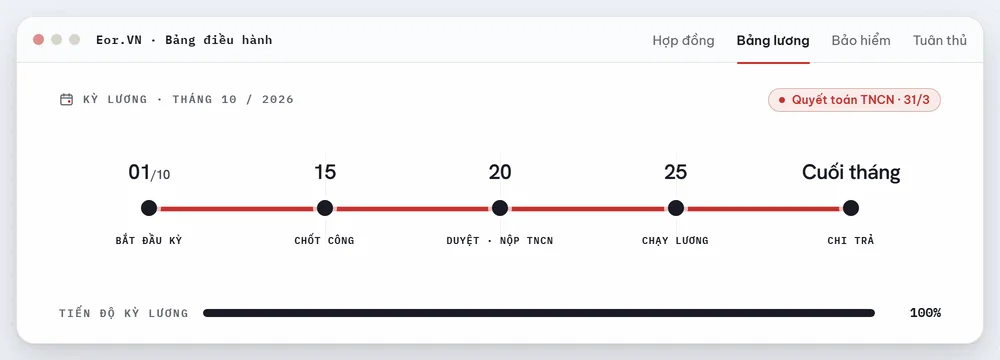
| Monthly, by the 20th | PIT withholding declaration for the previous month (monthly filers). |
| Monthly, by the last day | Social, health and unemployment insurance contributions paid; trade union fund remitted. |
| Quarterly, by the last day of the first month of the next quarter | PIT declaration for quarterly filers (smaller withholding amounts). |
| Annually, by 31 March | Employer PIT finalization for the prior calendar year. |
| Annually, before Tết | Not a legal deadline — but pay the 13th month before the holiday if you want your team to feel it counts. |
5. Paying people: currency, accounts, payslips
Vietnamese employees are paid in VND to local bank accounts — same-day domestic transfers are the norm. Foreign employees may be paid in foreign currency. Payslips are required; electronic delivery is standard. Salary must arrive on the agreed date — late payment beyond 15 days triggers statutory interest, and chronically late payrolls are the single fastest way to lose Vietnamese staff to the competition.
How Eor.vn runs it: inputs close on the 15th, you approve the draft on the 20th, payroll and your single invoice go out on the 25th, salaries land by the last working day, and every filing above happens on schedule under our name. One report shows gross, employee deductions, employer costs and our fee — reconcilable to the đồng.